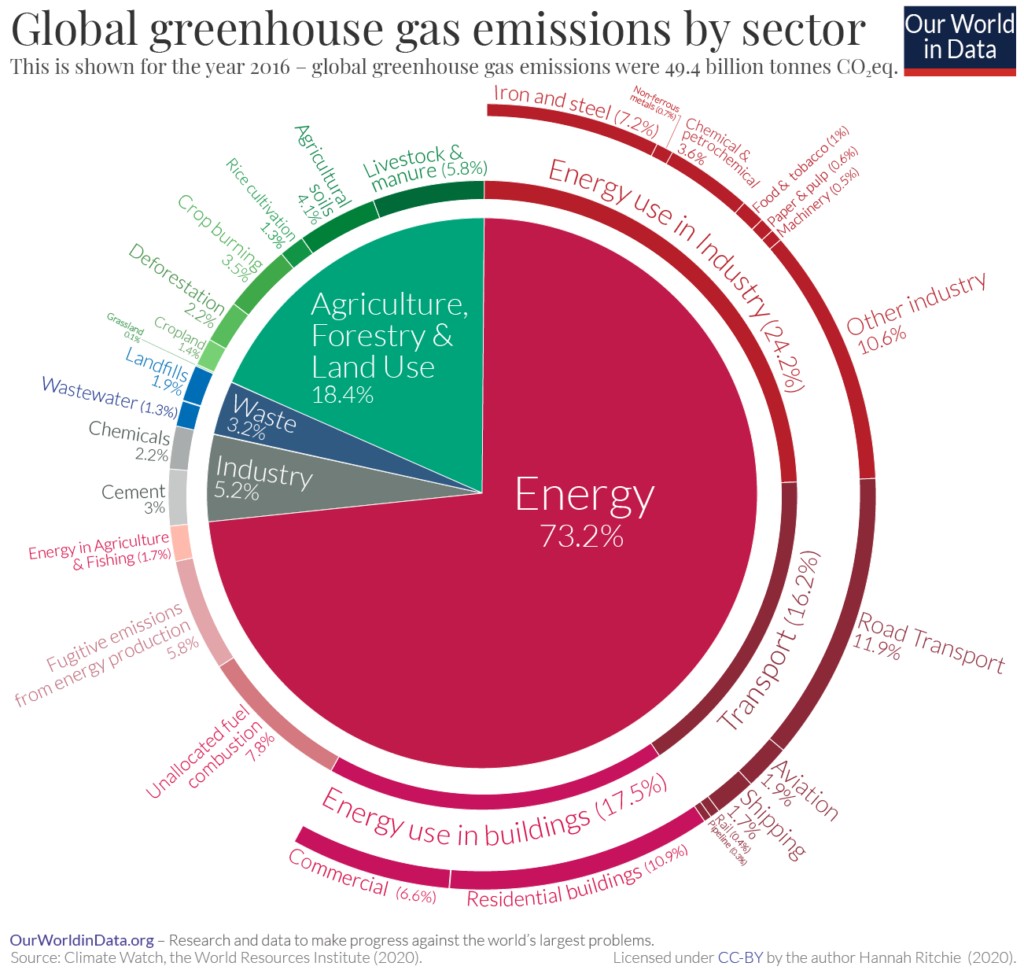
As global citizens, we often speak about climate responsibility in broad terms. Emissions, targets, policies. Yet the most meaningful shifts rarely come from abstract commitments alone—they emerge from practical decisions made every day, especially in business. Globally, greenhouse gas emissions reached close to 50 billion tonnes last year. Transport accounts for a significant share of that total, with logistics and shipping quietly underpinning many industries we do not immediately associate with heavy emissions. The food and beverage sector is one of them.
Water, in particular, is rarely part of the sustainability conversation—despite being served in every restaurant, hotel, and café, every single day.

Global breakdown of greenhouse gas emissions by sector, highlighting the dominant role of energy use and transport in overall carbon emissions
The Hidden Cost of Imported Bottled Water
In the food & beverage sector, environmental impact is often discussed in terms of ingredients, sourcing, and waste. Bottled water, however, tends to escape scrutiny. It is familiar, trusted, and deeply embedded in hospitality operations. Yet the journey from source to table is far from simple. Before a bottle ever reaches a guest, emissions are generated through glass production, water processing, bottling, quality testing, labelling, chilling, storage, and long-distance transportation. Each stage adds to the footprint. Transport alone represents one of the largest contributors, especially in regions where bottled water is imported at scale. A single glass bottle may seem insignificant but multiply its transport emissions across thousands—or millions—of units, and the impact becomes impossible to ignore.
Bottled-water logistics and supply-chain impact
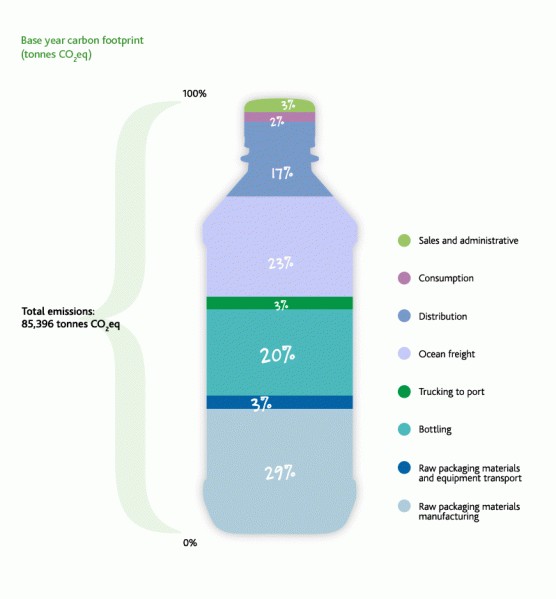
Transport and shipping contribute to bottled-water lifecycle impacts, but their share varies by source, bottle format, distance, logistics and assessment methodology. This makes logistics not just a cost centre, but a powerful opportunity for reduction.
By removing the need to ship water across borders—or even across regions—businesses can immediately lower emissions without altering guest experience. Fewer trucks. Fewer containers. Fewer kilometres travelled for something that already exists locally.
Assessing the supply chain can reveal opportunities to reduce bottled-water transport and handling.

Breakdown of the carbon footprint of imported bottled water, highlighting the dominant impact of packaging, bottling, and transportation.
One of the most persistent myths in hospitality is that sustainability requires compromise. In reality, technology has moved far beyond that trade-off.
AYR Water uses site-specific treatment configurations to enable venues to serve treated water on-site while reducing reliance on bottled water transported to the property. In hotels and restaurants with potable tap water, this approach is particularly effective: the resource is already there—it needs refinement.
The commissioned system is designed around the applicable drinking-water requirements and the venue’s service needs. Environmental outcomes depend on the existing supply model, installation and operating conditions.
Sustainability That Also Makes Economic Sense
Environmental responsibility does not exist in isolation from financial reality. Imported bottled water carries not only a carbon cost, but a recurring operational one: procurement, storage, breakage, logistics, and price volatility. AYR Water on-site filtration and bottling replaces this with predictability. Water can be produced as needed, with operating costs assessed against the property’s current bottled-water model. Over time, the savings are tangible—particularly for high-volume hospitality operations.
Reducing emissions and improving margins do not have to be opposing goals. In this case, they move in the same direction.
A Choice That Scales
Individual actions matter. But organisations can accelerate change at a scale that individuals cannot. A hotel, restaurant group or venue cluster may reduce reliance on thousands of transported bottles each year, depending on verified consumption and the implemented operating model.
Sustainability does not always require grand gestures. Sometimes, it begins with a simple question:
Does this still make sense?
When it comes to bottled water, the answer is increasingly clear. Choosing locally filtered, on-site water is not a trend—it is a logical evolution. One that reflects responsibility, refinement, and a commitment to progress that guests can see, taste, and trust.
Ready to assess your water service?
For restaurant and hotel managers, let’s connect and see the commercial benefits of switching from distributed bottled water to filtered on-site bottled water.
Our team can be reached at hello@ayrwater.com or through WhatsApp +6281139616518
Sustainable hospitality is not about doing more.
It is about doing what makes sense.
Sources
1 https://ourworldindata.org/ghg-emissions-by-sector
2 https://onlinelibrary.wiley.com/doi/abs/10.1111/j.1539-6924.2011.01695.x
3 https://iopscience.iop.org/article/10.1088/1748-9326/4/1/014009/meta